Turn your legacy applications into systems you can grow on.
CodeLift is a code modernization service that retires risk, technical debt, and outdated technology, while the business built on top keeps running, uninterrupted.
Standing still costs more than modernizing.
Every quarter a legacy system stays untouched, it gets more expensive to run, harder to hire for, and riskier to depend on. But most businesses don't modernize. Not because they don't want to, but because nobody can say with confidence what's actually inside the system, or how to safely change it. CodeLift starts where that confidence is missing.
One continuous loop, grounded in code.
Four stages that feed each other. The first three run on an engine that reads the source itself, not memory or guesswork; execution is delivered by our engineers. When the codebase changes, the loop starts over.
Understand
“What is this system, and how is it actually built?”
Reconstructed straight from the source: the real technology stack, every functional module, how they're coupled, and the data flows and integrations holding it together. Once the system is this clear, you can finally see where the risk is hiding.
A verified map, not a guess
Assess Risk
“Where is the danger, and how bad is it?”
Security, maintainability, complexity, and testability: four independent lenses that converge on the same root causes. That converged view is what turns into an actual plan, not just a list of problems.
Every finding cites a file and line
Plan
“What's the safest order to fix this?”
A phased path: stabilize what's exploitable today, make the code safe to change, consolidate scattered logic, then migrate feature by feature. From here, it's no longer a plan on paper. It starts moving.
A path, not a leap
Execute
“How do we move, without anyone noticing?”
The new system stands beside the old, one slice moves at a time, and the legacy platform is decommissioned only once it carries zero traffic. And because the codebase just changed, CodeLift is ready to understand the system again the moment it changes. The loop starts over.
Ready the moment things change
Don't take our word for it. See it in action.
A real CodeLift assessment on a production government platform. Open the live report to see how we map the system, surface evidence, and turn findings into a modernization plan.
Example system: e-District Uttarakhand
A state-wide citizen-services portal issuing certificates, running pensions and revenue cases, and processing payments. It handles citizens' PII, Aadhaar numbers, and legally-signed documents — used daily by citizens and officers across Uttarakhand.
459
.aspx pages
3,080
functions
16
modules
6
integrations
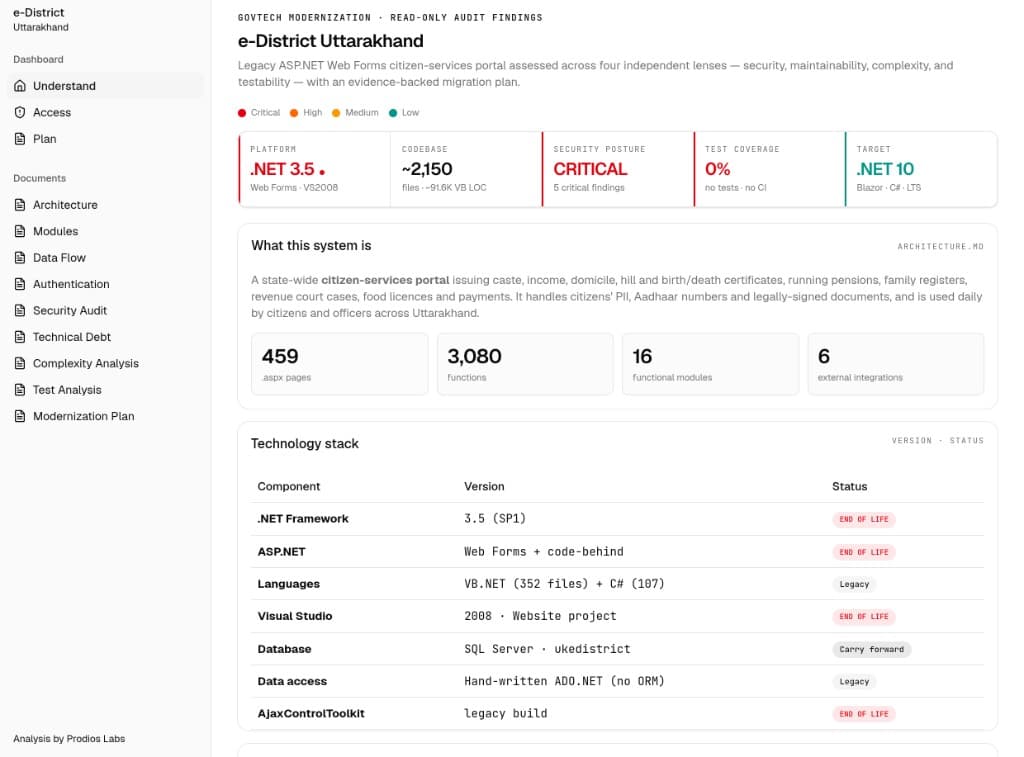
Understand
- Three-tier hub-and-spoke architecture: IIS → Web Forms → App_Code → SQL Server
- 16 functional modules sized by footprint, with risk concentration mapped per module
- Two parallel data paths — ad-hoc reads and Member* writes — both coupling through one database
- Home-grown auth model: MD5 challenge, ASMSAUTH cookie, master-page session gating
- 12-component technology stack with end-of-life status flagged (.NET 3.5, Crystal, CAPICOM)
- 6 external integrations traced (UMANG, PayGov, SMS, digital signature, employment SOAP)
Access
- CRITICAL security posture — 5 critical findings including plaintext secrets and SQL injection
- Four-lens scores: Security CRITICAL, Maintainability Poor, Complexity High, Testability None
- ~89 dangerous functions; god modules including BL.vb (2,176 LOC) and WebServicem.vb (2,173 LOC)
- Root causes converge across lenses — centralizing data access retires findings in all four registers
- Full risk register with severity, effort, priority, and file-and-line location for every finding
Plan
- Strangler Fig strategy — new app beside the old, migrated feature-by-feature, no switch-over day
- Four gates before deep work: project conversion, test safety net, critical security, CI/CD
- Phased roadmap: Stabilize → Enable → Consolidate → Migrate → Decommission
- 7 migration slices ordered low-risk to high-risk (public lookups through payments and reporting)
- Target architecture: .NET 10 Blazor, repository over Dapper, ASP.NET Core Identity
.NET 3.5 Web Forms.NET 10 Blazor · C# · LTS
View in reportAssessment tools stop at the report. Agencies start without one. CodeLift is both.
We have spent 10 years building and running government platforms, 15M+ applications processed, systems serving entire states. We modernize the kind of systems we've been trusted to build, so the plan is written by people who will stand behind the execution.
What we modernize
Four surfaces of the same system, assessed together and sequenced by where the risk actually is.
Application Modernization
The codebase itself, split into three problems that need three different tools. Refactoring cleans structure that's sound but has rotted at the edges. Re-engineering rewrites logic that's grown unrecognizable, without changing what it does. Re-architecting redraws the system's boundaries when the architecture itself is the risk. The assessment decides which one each module needs, module by module, never by default.
Refactor
For code where the architecture holds but the implementation hasn't: duplicated logic, dead branches, one function doing five jobs. We clean the structure in place, without changing what it does, so the next change is a diff instead of a gamble.
Re-engineer
For logic that needs rebuilding, not just cleaning: business rules buried three call-stacks deep in stored procedures, calculations nobody left can explain. We rewrite it against the current stack end-to-end and prove equivalence with parallel runs against the system it replaces.
Re-architect
For architecture that is itself the risk: a monolith with no service boundaries, one deployment unit standing in for a dozen concerns. We redraw the boundaries — decomposed into services, contracts where the couplings used to be — so scaling, deploying, and failing are no longer all-or-nothing.
Data Modernization
Every migration starts with the data underneath it: schemas frozen mid-decade, undocumented columns, values you can't trust until you've traced where they came from. We validate, clean, and move it onto systems your team can query directly, with corruption checks and a rollback path at every step.
UI/UX Improvement
The interface is usually the only part of the system citizens or officers ever see, and it's where the '20-year-old software' feeling lives. We rebuild it around the workflows people actually use — accessible, responsive, legible — without touching the logic underneath until that layer is ready to move too.
Technology Modernization
End-of-life frameworks, on-prem servers with no path to scale, integrations held together by FTP and cron. We move the stack forward deliberately — cloud-hosted, containerized, integrated through modern APIs — with the specific target set by the assessment, not by what's trending.
Ways to engage
Start with the assessment. Everything after it is driven by the evidence.
CodeLift Assessment
Fixed scope, days not months. The full triage: a verified system map, a four-lens risk audit, and a sequenced modernization plan.
Phased Modernization
We execute the plan slice by slice: stabilize, enable, consolidate, migrate. The old system retires only at zero traffic.
Continuous Loop
CodeLift re-reads the system as it changes, so the map, the risk view, and the plan never go stale.
Questions
Common questions about CodeLift and the modernization process.
What exactly is CodeLift?
A code modernization service by Prodios Labs. An AI triage engine assesses your legacy application straight from the source code, and our engineering team executes the modernization plan it produces.
How is it different from a code-quality tool?
Tools flag issues. CodeLift produces a decision: replatform, refactor, re-architect, or rebuild, with a sequenced plan behind it. And the same team that ran the triage can execute that plan.
What access does the assessment need?
Read-only access to the source code. No production access, no agents installed, no behavior changes.
How long does an assessment take?
Hours to days per application instead of weeks of senior-architect time. Findings arrive as a structured report where every finding cites a file and line.
Will you rewrite everything?
Almost never. A full rewrite is the slowest, riskiest default. The evidence decides the lightest safe path, and migration happens feature by feature beside the running system.
Is it only for government systems?
Government platforms are where we grew up, and enterprise legacy estates face the same physics. CodeLift works on both.


Know before you
rewrite.
Tell us about the system you're carrying. The first assessment will tell you, with evidence, what it really is.